google-site-verification: googlee335fbf16e4c0ec9.html
Visar inlägg med etikett Bitcoin. Visa alla inlägg

8 maj 2017

The 10 Biggest and Best Bitcoin mining Pools 2017


bitcoin mining poolNow that you have your Bitcoin mining hardware, your next step is to join the best Bitcoin mining pool.

What is a mining pool?

Mining pools are groups of cooperating miners who agree to share block rewards in proportion to their contributed mining hashing power.
While mining pools are desirable to the average miner as they smooth out rewards and make them more predictable, they unfortunately concentrate power to the mining pool’s owner.
Miners can, however, choose to redirect their hashing power to a different mining pool at anytime.

Get a Bitcoin Wallet and Mining Software

Before you join a mining pool you will also need Bitcoin mining software and a Bitcoin wallet.

The Biggest Mining Pools

The list below details the biggest Bitcoin mining pools. This is based on info from Blockchain’s pool share chart:

1. AntPool

Antpool is a Chinese based mining pool, maintained by BitMain. Antpool mines about 15% of all blocks.

2. DiscusFish/F2Pool

DiscusFish, also known as F2Pool, is based in China. DiscusFish has mined about 12% of all blocks over the past six months.

3. BitFury Pool

BitFury is one of the largest producers of Bitcoin mining hardware and chips.
BitFury currently mines about 12% of all bitcoins in three data centers across Georgia.
It’s a private pool and can’t be joined.

4. BTCC

BTCC is China’s third largest Bitcoin exchange. Its mining pool currently mines about 7% of all blocks.

5. ViaBTC

ViaBTC is a somewhat new mining pool that has been around for about one year.

6. BW Pool

BW, established in 2014, is another mining company based in China. It currently mines about 8% of all blocks.

7. BTC.Top

BTC.top is another new pool. It does not appear to have a website, so it may be a private pool.

8. Slush

Slush was the first mining pool and currently mines about 6% of all blocks.
Slush is probably one of the best and most popular mining pools despite not being one of the largest.

9. Bitclub.Network

Bitclub Network is a large mining pool but appears to be somewhat shady. We recommend staying away from this pool.

10. GBMiners

GBMiners is another somewhat shady pool that should probably not be joined.

Best Bitcoin Mining Pool Comparison

POOLLOCATIONFEESPRIVATE POOL
BitFuryGeorgia0%Yes
BTCCChina2-3%No
Slush PoolCzech Republic2%No
AntpoolChina1%No
BWChina1%No
The comparison chart above is just a quick reference. The location of a pool does not matter all that much. Most of the pools have servers in every country so even if the mining pool is based in China, you could connect to a server in the US, for example.

Which Countries Mine the most Bitcoins?

Bitcoin mining tends to gravitate towards countries with cheap electricity.
As Bitcoin mining is somewhat centralized, 10-15 mining companies have claimed the vast majority of network hash power.
With many of these companies in the same country, only a number of countries mine and export a significant amount of bitcoins.

China

China mines the most bitcoins and therefore ends up “exporting” the most bitcoins.
Electricity in China is very cheap and has allowed Chinese Bitcoin miners to gain a very large percentage of Bitcoin’s hash power.
It’s rumored that some Chinese power companies point their excess energy towards Bitcoin mining facilities so that no energy goes to waste.
China is home to many of the top Bitcoin mining companies:
F2Pool, AntPool, BTCC, and BW.
It’s estimated that these mining pools own somewhere around 60% of Bitcoins hash power, meaning they mine about 60% of all new bitcoins.

Georgia

Georgia is home to BitFury, one of the largest producers of Bitcoin mining hardware and chips. BitFury currently mines about 15% of all bitcoins.

Sweden

Sweden is home to KnCMiner, a Bitcoin mining company based in Stockholm. KnCMiner currently mines about 7.5% of all bitcoins.

US

The US is home to 21 Inc., a Bitcoin mining company based in California.
21 runs a large amount of miners, but also sells low powered bitcoin miners as part of their 21 Bitcoin computer.
Most of the hash power from the 21 Bitcoin computers is pointed towards 21’s mining pool. 21 Inc. mines about 3% of all bitcoins.

Other Countries

The countries above mine about 80% of all bitcoins.
The rest of the hash power is spread across the rest of the world, often pointed at smaller mining pools like Slush (Czech Republic) and Eligius (US).
If you cloud mine then you don’t need to select a pool; the cloud mining company does this automatically.

Why are Miners Important?

Bitcoin miners are crucial to Bitcoin and its security. Without miners, Bitcoin would be vulnerable and easy to attack.
Get this:
Most Bitcoin users don’t mine.
However, miners are responsible for the creation of all new bitcoins and a fascinating part of the Bitcoin ecosystem.
Mining, once done on the average home computer, is now mostly done in large, specialized warehouses with massive amounts of mining hardware.
These warehouses usually direct their hashing power towards mining pools.




10 apr. 2017

How To Avoid Bitcoin Cloud Mining Scams And Make Money

HashFlare
Want to know how to make the most money safely from a bitcoin cloud mining contract?

Bitcoin investment has grown day by day with cloud mining increasing as the new and most efficient strategy to making sound profits.
However, for you to invest in this area it requires dependence on Bitcoin cloud mining companies but very few are actually legit. Here is how you can know as well as avoid scamming Bitcoin cloud miner companies.
It is true that most of these legit Bitcoins cloud mining companies have hardware that is expensive but worth noting its ASIC vendors will voluntarily and out of appreciation make not only acknowledgment but also public posts of the company they are dealing with.
This is to point out that the company mentioned is one of their clients Worth noting is these advertisements are free, and as such, the cloud mining Bitcoin company in question acquires confidence.
As such, most Bitcoin cloud mining companies will request these so they can grind a better and firm kick off to the market as well as retain a highly competitive profile in the market. Therefore, there is no reason why any ASIC vendor wouldn’t support the company at hand

2. Data Center Photos

It is quite suspicious why a Bitcoin cloud mining company would provide you with details of their data center but when you request a relevant photo regarding the details provided, you are subjected to a couple of unreasonable excuses why they don’t have any photos.
Here is the warning- a legit Bitcoin cloud miner company should provide both the datacenter details and relevant photos for convenience and when asked for.
Think of a company that even goes to the extent of providing proof of electric bills or other costs - isn’t that one legit? Right, it is. Always bear in mind that companies can fake a data center- it only requires record videos and all is well, so take caution.

3. Public Address or User Selectable Mining Pool
A legit Bitcoin cloud hashing company will have a public mining address- it is a sign of proof and evidence that the company, like Hash Flare, is mining their available bitcoins on a network.
However, you should keep an eye out since some companies have been known to have borrowed and faked address that they don’t own.
Along with this, to check whether the company at hand owns the address or not you can request the company to sign blocks and if it is unable then it’s likely the company doesn’t own the address.
On this line, it is worth noting that only those companies that can sign blocks own the said address- it’s the whole magic of attesting the legitimacy of a Bitcoin cloud miner company.
Did you know that for any scam Bitcoin cloud hashing company that you purchase bitcoin hardware and hashing power from they aren’t able to no strictly direct the purchased hashing power to your preference mining pool? That it is

4. Anonymous Domain Registration

Run run run if you come across any Bitcoin cloud mining company website that is anonymous- it’s just a one-step clarification that the company is a scam. But why?
Allow me to take you through- any owner of any cloud hashing company website domain should never at any moment be anonymous since they provided full contact details during the registration process of their website domains.
As such, a legit Bitcoin cloud hashing company website domain will not appear as anonymous and one can view all their contact details with ease- they are not hidden. It's only scammers who will hide their contact details to eliminate any chance of being tracked.

5. Social Networking


6. Lack Withdraw Option

Since Bitcoin cloud miner then for any company that you engage with, it should allow you to both sell the GH as well as withdraw your earnings.
However, scammers will always act opposite- they will allow you to sell the GH, buy on their website and there is no specific place you can withdraw your earning; that’s weird, and it should tell you that something is wrong and that’s why you will need to leave the site.
Also, if the company doesn’t credit any trade or sale option of your cloud contract GH or TH, be assured it’s a scamming site- run run run away.

7. Offer Guaranteed Profit

Scammers use any sensible and attractive way to get you on their site and that’s why, you will find some Bitcoin cloud hashing companies offering a denominated or guaranteed profit- this should put up a red flag and tell you to stay away, why?
In the bitcoin mining world there is no such thing as certain profit- oh no!
Worth noting is, the bitcoin mining world is so hard to predict and as such, no one can even state tomorrow’s BTC price let alone weeks or months to come- so why are they guaranteed profits? It’s the incentive of scammers.

8. Unlimited IPO

Did you know that the amount of GH that you can sell is always limited by your data centers- the amount of mining hardware in it?
Yes, as such legitimate companies will always have limitations particularly on the amount of GH one can sell besides stating how much GH they can access not to forget the amount that has been sold.
Worth noting is, the process of getting more hardware in a bid to sell more GH will always consume more time during the ordering and delivery process. As such, any company that doesn’t limit sales is very likely a scam- BEWARE!!
Scam cloud hashing companies are out there and only through the above tips can you avoid them- BEWARE!! If you do see one, stay away.
HashFlare

Is Bitcoin Cloud Mining Actually Profitable?

Many people wished they had not missed the Bitcoin mining bus before the great Bitcoin boom started back in 2013. Back then you could mine Bitcoins pretty easily at home and make a very nice profit on the exchange rate. However since then, the mining difficulty has increased immensely and today it is almost impossible to mine Bitcoin profitably at home with your own hardware. The only exception is if you have very low electricity costs and manage to mine efficiently for at least 6 months without any major changes in this competitive landscape.

HashFlare
And that’s one of the reasons cloud mining was born
A seemingly sophisticated way to allow people to jump on the Bitcoin mining bus without the need of costly expenses. With cloud mining you can virtually rent mining equipment from a company that will give you back the profits from your rented mining rigs.You do not need to deal with the electricity costs, cooling down the miners or storing them, all you need to do is send out a periodical payment and you are all set. Of course this cloud mining idea quickly took off as people are always looking for new ways to make money online, however how legit and profitable are these cloud mining contracts? That’s exactly what I’m about to unveil in the following post.
99% of cloud mining companies are complete a Ponzi scheme
How do I know this? Well, I run a website dedicated to helping people get started with Bitcoin and every day I get another complaint about another cloud mining company that does not pay and the website seems to have gone away. Even Gavin Andresen, the previous chief scientist of the Bitcoin Foundation who has now been widely discredited because of his involvement with the charlatan Craig Wright, once said:
“I suspect many of them will turn out to be Ponzi schemes.”
Also just looking at our cloud mining reviews page you can see the amount of fraud and companies that fail to payout.
When consider a cloud mining company make sure to due your due diligence on every company you think of investing in. One the tools created for this task is the Bitcoin scam test. If it does not pass the test - do not invest.
But even if you do find a legit cloud mining company is it really worth your money? Let’s put one of the most profitable cloud mining companies to the test - Hashflare

Doing the math

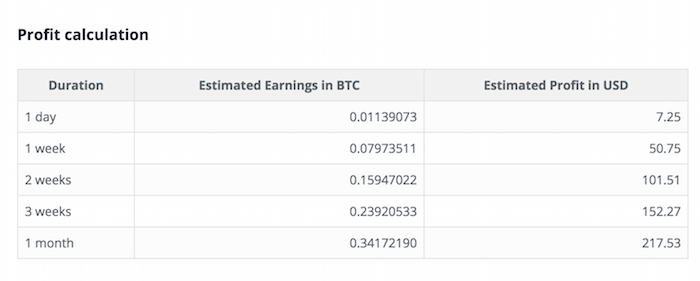
If you go to the company’s pricing page and purchase 10Th/s of Bitcoin mining power (SHA-256) it will cost you $1,200 or the equivalent in Bitcoins around October 17, 2016. If I use a Bitcoin mining calculator and try to predict my profits with 10Th/s of mining power assuming I have no other expenses I get the following results:
So after one month I make around 0.34172190 Bitcoins (~$217), meaning after 1 year I will make around 4.1 Bitcoins. Seems pretty profitable, this means that I’ll break even after about six months and from there on it’s pure profit.
But here’s the kicker, something called MEF - Maintenance and Electricity Fees. For Hashflare they are as followed: The MEF is linear and equals 0.0045 USD per every 10 GH/s of SHA-256 and 0.01 USD per every 1 MH/s of Scrypt. Ethereum contracts are not subject to any fees.
So let’s go back to our investment and calculate in the fees. 0.0045USD per 10GH/s per 24 hours = $4.5/day (since I’m using 10Th/s).
So in one month this adds up to $135. So now we’re making only $82/m and are breaking even in about 15 months. If everything stayed constant in the Bitcoin universe I’d only get my money back after a year and 3 months. After that I’d be doing $82/m in revenue which is 6.8% monthly interest. However, if you take a look at Bitcoin’s historical price figuresyou see that nothing ever stays constant for such a long time. Exchange rates will fluctuate and mining difficulty will probably increase.
Assuming the BTC exchange rate rises you’ll be making more money and so will the mining company. However, if that’s the case then perhaps you would have been better off just holding on to those $1200 in Bitcoin to begin with.
And if Bitcoin’s price drops? Well it’s going to take you a lot more time to break even. However since the cloud mining company already cashed out on you as a customer when you signed up they don’t really care. Also, if BTC’s price falls so low that it’s no longer profitable to mine you won’t be getting anything which can make your break even time become infinate.
However, the examples given above are actually the best case scenario where the company you invest in actually has mining equipment. Most of the cloud mining site today are unfortunately Ponzi schemes masquerading as legit investments. Usually they’ll just take money from newcomers and pay it out to senior members and themselves until this whole scheme finally falls apart and the site goes down.
Bottom line - Cloud mining companies are usually always like a casino - the house always wins. If you do start making profits with them it is after a very long and risky period in which Bitcoin’s price probably went up and you could have made more money by just HODLing.
Be careful with your bitcoins!